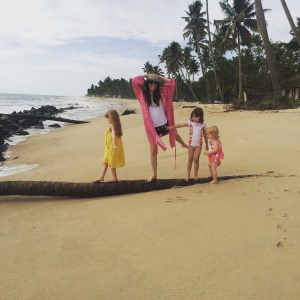
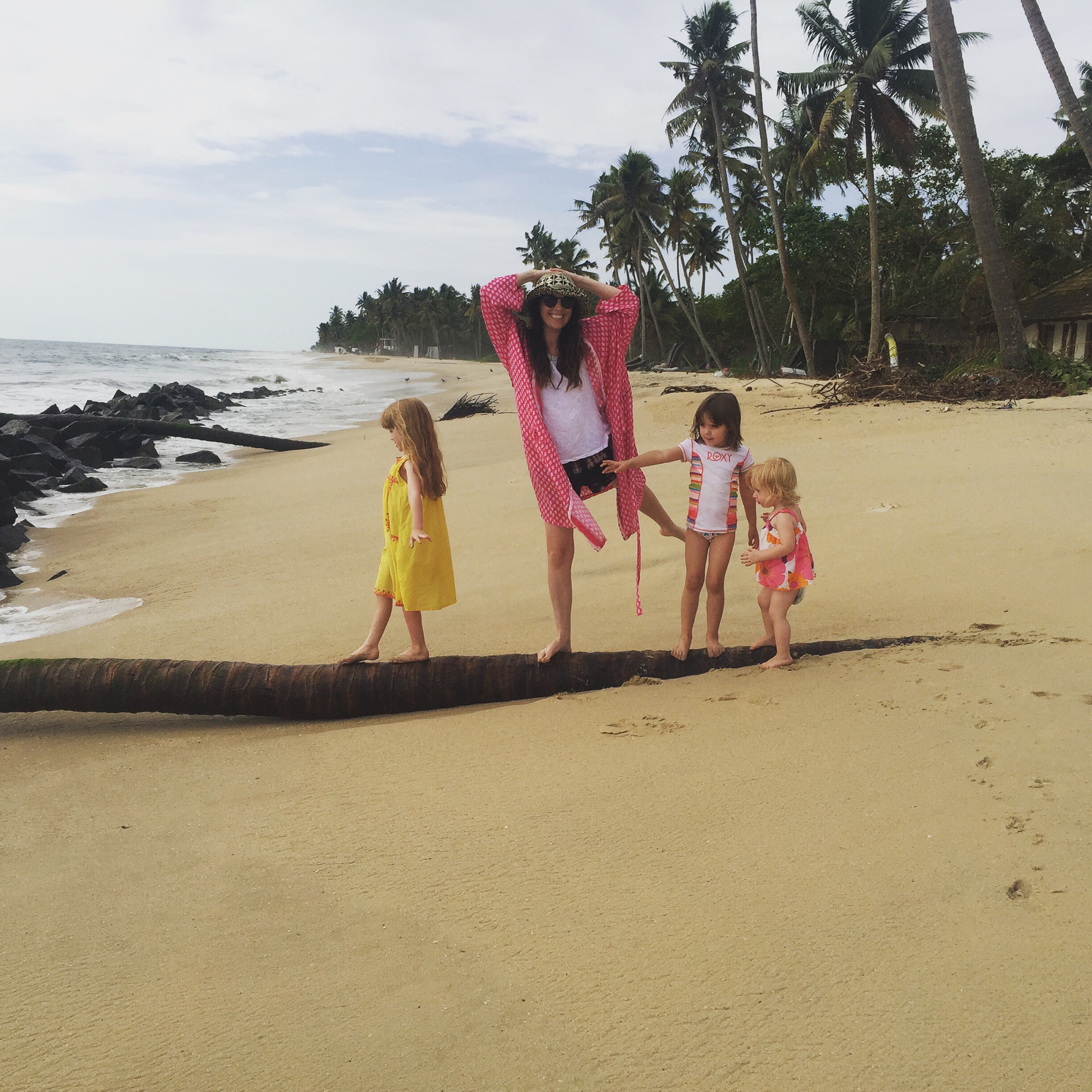


As I write this it’s about 8pm and Masan, Evie and Mia are standing on the porch looking at all the sand crabs who have come out of hiding now that the ruckus of sand play has ended for the day. They stand stock still as the girls squeel and point. A few startled crabs run for their holes for cover. “That one’s so fast it’s moving like a rocket, Dad!” And “Mom, I spit some toothpaste on that one so it could taste it. I think he liked it because he didn’t move.” There have been many little moments like this during our time in Kerala that stand out as being perfect and memorable.
After being in India for almost 6 weeks, the knowledge that all this ends in a about year and 10.5 months weighs heavily on my mind. I know that seems like a long time from now, but time at my age zooms. And perhaps in a few days, weeks, or months living in India will feel like a jail sentence rather than an opportunity, but not right now. So we need to see and explore before its time to go back home. But where to go during monsoon season in southern India? In typical India fashion, if you can outsource it for a good price, do it. For a small price a travel agent gave us a few options for a first trip out of Bangalore, and a quiet beachfront villa at Marari Beach near the town of Kochi in the southern Indian state of Kerala seemed like an easy and doable first trip with this crew.
The flight from Bangalore was a quick hour and 20 minutes. Flying over Kerala a fellow passenger and native of Kerala pointed out waterfalls out the window to our right. Even from flying height the beauty of Kerala was stunningly obvious-this state is probably the polar opposite of the city of Bangalore-and most likely all the other cities in India (tbd). Spongey bright green is everywhere, and our lungs don’t hurt when we breathe. That annoyingly persistent cough is gone as is that smell that permeates Bangalore. Instead of piles of molding trash along the roadsides there are lush trees and tropical plants.
A few moments from the trip thus far:
We stayed at the Marriott near the airport the evening we landed in Kerala. While we were swimming in the pool a crow grabbed my packet of tissues that was resting on the chaise lounge and flew off with it. He held on tight and never dropped it. There have been several occasions during this trip that the tissues would have come in handy doubling as toilet paper.
The drive to Mararikulum and our second hotel involved an hour long wait for a 5 minute ferry ride. Apparently a bridge wouldn’t have worked because large ships like the Queen Mary are constantly going through the harbor. The ferry was packed with cars, mopeds, and pedestrians coming from a Muslim wedding. The docking of the ferry involved ramming the boat into the shore, which jolted everyone, and involved some minor pedestrian injuries. No big scene was made or assistance requested, however.
After the ferry ride we stopped at Fort Kochi, a historic fishing village and huge tourist area for lunch. Fort Kochi was given to the Portugese in 1503 by the Rajah of Kochi after they helped him out defeating an enemy. Vasco da Gama, who if you remember from 5th grade history, which I didn’t, was the first European to land in India. He was buried for a time at St. Francis Church in Fort Kochi. In 1683 the Dutch captured the city and tore down some of the gorgeous Catholic Churches and convents. In 1795 it was the British’s turn to take control. Finally, in 1947 it was back in the hands of India.
Fort Kochi was an interesting mix of Christian churches, Muslim mosques, Jewish temples, probably some Hindu temples, although those weren’t visible from the narrow road, and lots of Western tourists. We saw more white people in Fort Kochi than we had in 6 weeks in Bangalore. Like any touristy beachside town in all the world, there were people with long dreads and smoked out eyes alternately staring past or glaring at us while walking past, and hemp seashell jewelry decorating thin, tanned wrists and necks and plump white ones in equal number. Unlike other places in India a family of white Americans drew zero attention, except from the young, English speaking con-artist who showed up as soon as we sat down for lunch at a roadside cafe. The timing was too perfect for him not to have been tipped off by the restaurant staff, which was confirmed when he gave them part of what we ended up paying him. I wasn’t interested in his wares until he told us he was a member of a college artist collective selling their supposedly hand painted Indian scenes on antique, recycled paper. I wanted to atleast see the paintings painted with handmade sand paint. They were pretty and looked handmade, and after showing us about a hundred how could we not buy any? So we bought a few for way too many rupees, even though we haggled, and were later told by the driver that these were mass produced and that we paid triple what they were worth. This exchange was like buying one of those ubiquitous hand painted name signs sold on the streets of New York for way too much money. Or even worse, it was like getting suckered into a game of Three Card Monte near Washington Square Park in the late 90’s, not knowing it was a scam and that everyone around the table was in on it but you, the mark. As a New Yorker I pride myself on not being the typical, deer in headlights in the big city tourist, but India has turned me into one.
The road from Fort Kochi to Marari Beach was called the Coastal Highway, which may bring to mind a highway along the ocean, maybe California’s Pacific Coast Highway. Kerals’s version was nothing like that. It was a windy, 2 lane, dotted white lined road resembling a backwoods country road in all but road usage. Along both sides were green trees, shrubs, grass, dirt, dilapidated shacks and huge, gorgeous homes side-by-side, almost on top of each other with no views of the coast. Everyone seemed to be using the Coastal Highway at once in whichever way suited their needs best. Men, women, and children used it as a sidewalk causing the cars, auto rickshaws, busses, and mopeds to swerve into oncoming traffic to avoid hitting them. Chickens, goats, cats, dogs, and an occasional cow spilled into the road frequently from sloped front yards. Cars pulled over frequently for church, funeral processions, or to shop at small stands. No one was concerned about being hit by a car, especially the man who fell down drunk in the middle of the road and decided to stay there.
Kerala is a communist state. But a very Indian, live and let live kind of Indian communism. According to the driver we hired for the trip, being wealthy is no problem and being poor is no problem, but all kids go to school.
Also according to our driver, liquor licenses cost $7500 US a year, which caused about 400 bars to close. Apparently the government thought too many people were drinking too much. So alcoholic drinks are pretty much non-existent at cafes and restaurants unless the proprietor is serving beer illegally in a coffee mug like ours did today.
Men in Kerala favor the Mundu, which is one piece of cloth which ties at the waist and flows to the ankle. It can be raised to the knees to allow comfortable walking. I was impressed with its beauty and practicality. Most of the men we saw wearing the Mundu wore a clean, crisp, collared, colorful button down shirt with it, which to me screamed business on the top, weekend on the bottom.
Tomorrow we stay overnight on a houseboat-the same one Prince Charles stayed on for his 65th birthday. More stories to come.

 Brooklyn Mama in India